Top myths about using positive reinforcement as a technique in dog training
While there are many myths about using positive reinforcement in dog training, here are some common ones, that you are likely to come across.
I will bust some myths below!

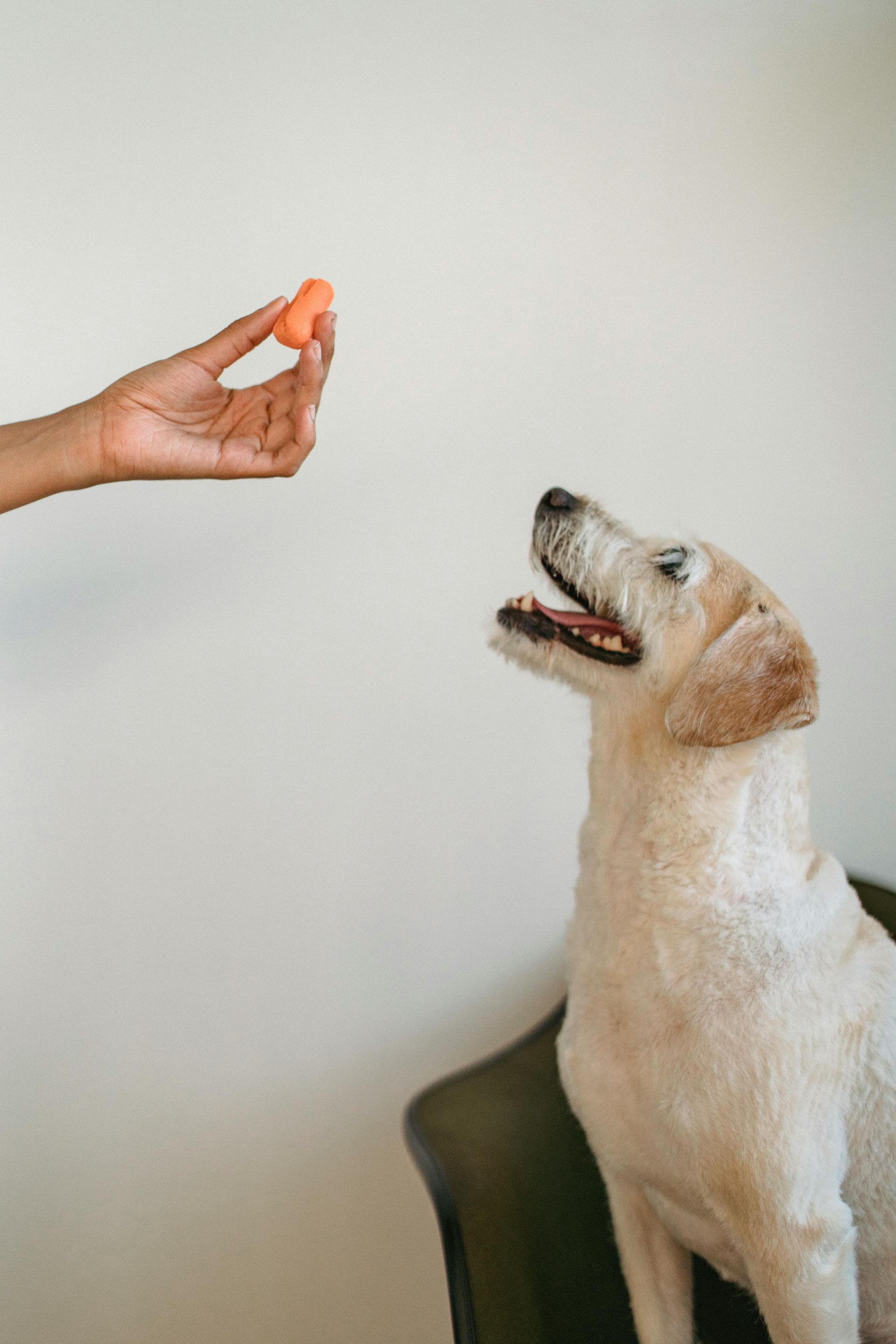
Myth 1: Food is used as a bribe to get the dog to do what you want.
Truth: Food is an important tool when it comes to training many dogs, as it is highly valued by them. However the reward of food is given after a dog has offered a behaviour that you like. It is not dangled in front of the dogs face while they are asked for a behaviour. A treat pouch can be utilised to keep the treats in. Like learning anything new the dog needs to be set up for success (not learning in too difficult environments to begin with and building up to those), and rewarded for small behaviours that add up to the final desired behaviour. This is a concept called shaping. For example, for a dog you are teaching to move into a down you’d reward them for small movements that they’d make towards a down, otherwise it is likely that they’ll get frustrated.
Some people argue that a dog will gain weight if food is used too much but you can always use your dog’s daily allowance of food. Treats do not have to be huge and cut up into very small pieces.
I’ve heard it all, that a dog should want to please us. I think this is very unrealistic as everyone does something because there is a consequence involved. People would not go to work if they were not paid. While of course, there are some dogs that have some traits that are more inherent and easier to train a dog won’t do something just to please us. Certainly, they do please us, that’s why we adore them, but it is unrealistic to think that they will only do things for no reinforcement. Sometimes, if you completely stop using food in training then behaviours can become extinct.
Myth 2: There are no boundaries involved
Truth: There have to be boundaries to keep dogs safe. A lead, for example, in the case of polite walking does this. If you are training a dog not to pull, and it’s from a lack of training issue, then rewarding a dog when they are walking politely will reinforce polite walking (positive reinforcement training), and stopping to prevent the dog from pulling while they are on the lead prevents them from moving forward while they pull (negative punishment). Positive reinforcement means adding something to make the behaviour more likely and negative punishment means withholding rewards (i.e stopping so they do not gain access towards what they are pulling).
There are likely to be times you will need to pull a dog’s lead to get them out of a situation for safety: maybe they have pulled towards the road. However there is a difference between pulling them away and yanking on their collar in an attempt to punish them for their behaviour. Equipment such as harnesses which have a front and back clip can be good safety tools. When training something new, the environment is key, just like a young child who won’t be able to do their Maths homework while eating jelly and ice cream on a bouncy castle, a dog won’t be able to learn recall straight away if there first lesson is around copious amounts of other dogs, smells and people.
Myth 3: People who use this form of training have little control over their dogs.
Truth: Studies have suggested that positive reinforcement training and negative punishment are more effective than aversive techniques (Ziv et al., 2017). Dogs who experience aversive training (hitting, shouting, aversive tools such as prong collars) have been shown, under some studies, to be more aggressive and unpredictable. Aversive techniques are not welfare based training techniques.
Dog training can be based on connection and not correction. Rewarding them for polite behaviour that you’d like to see more of and actively noticing the good things that they are doing can reap rewards. By responding to your dogs and noting their triggers and hot spots (where the behaviour occurs) you can effectively respond to them to set them up for success and change environment if needed. You can work at building self control in these areas that they are distracted in. If it is a behavioural concern i.e if a dog is scared of other dog then I argue that people who use a flooding technique where a dog is surrounded by other dogs in an attempt to get them over their fear, are the one’s that are not in control. The dog may bark and lunge and get the other dog to move away, or even snap or bite. Trigger or stress stacking is when behaviours that are scary, painful and stressful add up and a dog reacts in a way that they may not do normally, had those other stressors not occurred in quick succession.
Myth 4 : Positive reinforcement does not work on certain dogs.
Truth: It’s used with animals who live in zoo’s and assistance dog charities. It certainly does work. However, there is a caveat there is sometimes a misunderstanding about how positive reinforcement works and how it is supposed to be used. You can sometimes reward at the wrong time and therefore teach the wrong thing. If a treat is given after a person speaks or while a dog eats a treat then the link between the word and the prediction of the treat is low. Whereas if the word is given first and the treat follows a link can be made between the word and the reinforcement. This is particularly important when training a recall word.
Myth 5: It only involves food.
Fact: There are many things a dog finds reinforcing and they can be ranked in order of preference to dogs. They can include toys, treats, favourite things to have, favourite places to be. By ranking them, the high value rewards can be used for more difficult tasks. Imagine your primary motivator was money because you were going to use that money to go on holiday with your partner after a stressful year. You also like cookies but they are lower down the rank of favourite things. You work really hard on a project at work and expect a bonus but instead you get some cookies, your less likely to work as hard the next time! The same things can happen with dogs. If you are giving them a piece of kibble, something that they have every day for coming away from 7 dogs they love to play with then this may not be as rewarding for them. It can also feel like a downgrade if on previous occasions they’ve received something high value such as a great play session or a treat they find very tasty.
Do you want to learn more about training? Or is there anything in here you find surprising? Come and join me over on Facebook.
References
Ziv et al., (2017), 'The effects of using aversive training methods in dogs—A review', Journal of Veterinary Behavior